Home Forums Articles How To's FAQ Register
Go Back   Xoutpost.com > Off-topic > The Lounge
Arnott
User Name
Password
Member List Premier Membership Today's Posts New Posts

Xoutpost server transfer and maintenance is occurring....
Xoutpost is currently undergoing a planned server migration.... stay tuned for new developments.... sincerely, the management


Closed Thread
 
LinkBack Thread Tools Display Modes
  #1  
Old 07-25-2008, 08:31 PM
x5GuyInLA's Avatar
Member
 
Join Date: Jul 2005
Location: West Los Angeles, CA
Posts: 987
x5GuyInLA is on a distinguished road
From Ballin' to Bawlin'

I guess he caught the MC Hammer syndrome.

http://www.palmbeachpost.com/blogs/c...ch_tumble.html

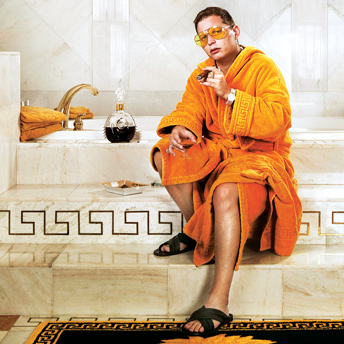
‘Hip-Hop’s Liberace’ Storch tumbles into foreclosure

The famed hip-hop producer who tried to make singing sensations out of Paris Hilton and Brooke Hogan could soon be homeless.

SunTrust Bank moved earlier this month to foreclose on the $10 million Miami home of Scott Storch, according to Miami-Dade County records obtained by Page 2.1.

Storch, who helped make a Christina Aguilera a household name and worked for the likes of Beyonce, may have been worth $70 million as late as last year.

It’s been a lighting-quick fall from grace for the 34-year-old Storch, who once made the cover of Rolling Stone magazine under the headline: Hip-hop’s Liberace.

Storch was known to drive around SoFla in Rolls-Royces or Ferraris, spending hundreds of thousands in local nightclubs and keeping an entourage that would make Sean Combs blush with envy.

In his blinged-out heyday, Storch signed for two SunTrust mortgages worth a combined $7.75 million so he could buy a 10-bed, 16-bath mansion on Miami’s Palm Island. He hasn’t made monthly payments for most of this year, even after borrowing another $170,000 from friends, according to court papers.

Storch’s sprawling home also has been liened by an electric company for $11,215 and a security system installer. Storch still owes $17,151 for his state-of-the-art camera network — a system that couldn’t keep out repo men.

Over the past month, Storch saw his Ferrari Scaglietti and his prized motorcycle, a Bones Bike, repossessed.

Storch’s lawyer, Guy Spiegelman, didn’t return calls. But two weeks ago, he described Storch’s problem in an interview with the Associated Press as “a cash flow problem.”

Riding the popularity of a unique sound that blended techno and Middle Eastern riffs, Storch tried to make his then-galpal Hilton into a singer in 2006. But the songs he’d come up with were deemed too sexual for radio. A year later, his album for Hogan flopped.
Storch hasn’t had a hit since then.

Sponsored Links

  #2  
Old 07-25-2008, 09:44 PM
FSETH's Avatar
Member
 
Join Date: Apr 2007
Location: Marietta, GA
Posts: 5,302
FSETH is on a distinguished road
If you look up douchebag in the dictionary, I am pretty sure you sill see more photos of him.
  #3  
Old 07-27-2008, 07:12 AM
Member
 
Join Date: Nov 2007
Location: Los Angeles
Posts: 749
lakai is on a distinguished road
perfect example of being n***er rich.
  #4  
Old 07-27-2008, 07:45 AM
Wagner's Avatar
..make it happn' capn'
 
Join Date: Mar 2005
Location: Mt. Airy, MD
Posts: 17,747
Wagner is on a distinguished road
two words..."ha ha"
__________________

An unwavering defender of those I see worth protecting.

"promote the general welfare, not provide the general welfare"

We the People of the United States, in Order to form a more perfect Union, establish Justice, insure domestic Tranquility, provide for the common defence, promote the general Welfare, and secure the Blessings of Liberty to ourselves and our Posterity, do ordain and establish this Constitution for the United States of America.

  #5  
Old 07-27-2008, 12:18 PM
streetsoffire's Avatar
Member
 
Join Date: Jul 2006
Posts: 694
streetsoffire is on a distinguished road
lakai: Please explain, "nigger rich"........
__________________
Die Perfekte Verbindung Aus Sportlichkeit und Asthetik
  #6  
Old 07-27-2008, 12:50 PM
Wagner's Avatar
..make it happn' capn'
 
Join Date: Mar 2005
Location: Mt. Airy, MD
Posts: 17,747
Wagner is on a distinguished road
Quote:
Originally Posted by streetsoffire
lakai: Please explain, "nigger rich"........
Watch the movie Boiler Room, it is an exact line from it.


Don't


Read


Any


Farther


if


you


don't


want


the


quote.


Boiler Room:

GREG: Those fucking Guineas, half of them do coke. They all drink. No stability, zero capital. They make all this money and they're always living three steps ahead. Do you know there are guys in this firm that make close to a million a year and couldn't get a loan for a Honda because their credit is so bad. Everyone's just waiting for the fifteenth of the month. It's like they may drive a Porsche but they don't have ten bucks to put in the gas tank. Nigger rich.
__________________

An unwavering defender of those I see worth protecting.

"promote the general welfare, not provide the general welfare"

We the People of the United States, in Order to form a more perfect Union, establish Justice, insure domestic Tranquility, provide for the common defence, promote the general Welfare, and secure the Blessings of Liberty to ourselves and our Posterity, do ordain and establish this Constitution for the United States of America.

  #7  
Old 07-27-2008, 01:19 PM
Member
 
Join Date: Nov 2007
Location: Los Angeles
Posts: 749
lakai is on a distinguished road
If you're serious, Take your pick..

http://en.wiktionary.org/wiki/nigger_rich

http://www.urbandictionary.com/defin...rm=Nigger+Rich

http://www.amazon.com/Growing-Up-Nig.../dp/1565549635

Chris Rock - Wealth


Inconspicuous Consumption

The Atlantic Monthly
Virginia Postrel
July/August 2008


Quote:
About seven years ago, University of Chicago economists Kerwin Kofi Charles and Erik Hurst were researching the “wealth gap” between black and white Americans when they noticed something striking. African Americans not only had less wealth than whites with similar incomes, they also had significantly more of their assets tied up in cars. The statistic fit a stereotype reinforced by countless bling-filled hip-hop videos: that African Americans spend a lot on cars, clothes, and jewelry—highly visible goods that tell the world the owner has money.

But do they really? And, if so, why?

The two economists, along with Nikolai Roussanov of the University of Pennsylvania, have now attacked those questions. What they found not only provides insight into the economic differences between racial groups, it challenges common assumptions about luxury. Conspicuous consumption, this research suggests, is not an unambiguous signal of personal affluence. It’s a sign of belonging to a relatively poor group. Visible luxury thus serves less to establish the owner’s positive status as affluent than to fend off the negative perception that the owner is poor. The richer a society or peer group, the less important visible spending becomes.

On race, the folk wisdom turns out to be true. An African American family with the same income, family size, and other demographics as a white family will spend about 25 percent more of its income on jewelry, cars, personal care, and apparel. For the average black family, making about $40,000 a year, that amounts to $1,900 more a year than for a comparable white family. To make up the difference, African Americans spend much less on education, health care, entertainment, and home furnishings. (The same is true of Latinos.)

Of course, different ethnic groups could simply have different tastes. Maybe blacks just enjoy jewelry more than whites do. Maybe they buy costlier clothes to deter slights from racist salesclerks. Maybe they spend more on cars for historical reasons, because of the freedom auto travel gave African Americans during the days of segregated trains and buses. Maybe they just aren’t that interested in private colleges or big-screen TVs. Or maybe not. Economists hate unfalsifiable tautologies about differing tastes. They want stories that could apply to anyone.

So the researchers went back to Thorstein Veblen, who coined the term conspicuous consumption. Writing in the much poorer world of 1899, Veblen argued that people spent lavishly on visible goods to prove that they were prosperous. “The motive is emulation—the stimulus of an invidious comparison which prompts us to outdo those with whom we are in the habit of classing ourselves,” he wrote. Along these lines, the economists hypothesized that visible consumption lets individuals show strangers they aren’t poor. Since strangers tend to lump people together by race, the lower your racial group’s income, the more valuable it is to demonstrate your personal buying power.

To test this idea, the economists compared the spending patterns of people of the same race in different states—say, blacks in Alabama versus blacks in Massachusetts, or whites in South Carolina versus whites in California. Sure enough, all else being equal (including one’s own income), an individual spent more of his income on visible goods as his racial group’s income went down. African Americans don’t necessarily have different tastes from whites. They’re just poorer, on average. In places where blacks in general have more money, individual black people feel less pressure to prove their wealth.

The same is true for whites. Controlling for differences in housing costs, an increase of $10,000 in the mean income for white households—about like going from South Carolina to California—leads to a 13 percent decrease in spending on visible goods. “Take a $100,000-a-year person in Alabama and a $100,000 person in Boston,” says Hurst. “The $100,000 person in Alabama does more visible consumption than the $100,000 person in Massachusetts.” That’s why a diamond-crusted Rolex screams “nouveau riche.” It signals that the owner came from a poor group and has something to prove.

So this research has implications beyond race. It ought to apply to any peer group perceived by strangers. It suggests why emerging economies like Russia and China, despite their low average incomes, are such hot luxury markets today—and why 20th-century Texas, a relatively poor state, provided so many eager customers for Neiman Marcus. Rich people in poor places want to show off their wealth. And their less affluent counterparts feel pressure to fake it, at least in public. Nobody wants the stigma of being thought poor. Veblen was right.

But he was also wrong. Or at least his theory is out of date. Given that the richer your group, the less flashy spending you’ll do, conspicuous consumption isn’t a universal phenomenon. It’s a development phase. It declines as countries, regions, or distinct groups get richer. “Bling rules in emerging economies still eager to travel the status-through-product consumption road,” the market-research group Euromonitor recently noted, but luxury businesses “are becoming aware that bling isn’t enough for growing numbers of consumers in developed economies.” At some point, luxury becomes less a tool of public status competition and more a means to private pleasure.

In Veblen’s day, the less affluent scrimped on their homes in order to keep up appearances in public. “The domestic life of most classes is relatively shabby, as compared with the éclat of that overt portion of their life that is carried on before the eyes of observers,” Veblen wrote, noting that people therefore “habitually screen their private life from observation.” By contrast, consider David Brooks’s observation in Bobos in Paradise that, for today’s educated elites,

it’s virtuous to spend $25,000 on your bathroom, but it’s vulgar to spend $15,000 on a sound system and a wide-screen TV. It’s decadent to spend $10,000 on an outdoor Jacuzzi, but if you’re not spending twice that on an oversized slate shower stall, it’s a sign that you probably haven’t learned to appreciate the simple rhythms of life.
Virtuous or vulgar, what all these items have in common is that they’re invisible to strangers. Only your friends and family see them. Any status they confer applies only within the small group you invite to your home. And the snob appeal Brooks pokes fun at corresponds to the size of the audience. Many friends may see your Jacuzzi or media room, but unless you’re on HGTV, only intimates will tour your master bathroom. A slate shower stall may make you feel rich, but it won’t tell the world that you are. As peer groups get richer, the balance between private pleasure and publicly visible consumption shifts.

Russ Alan Prince and Lewis Schiff describe a similar pattern in their book, The Middle-Class Millionaire, which analyzes the spending habits of the 8.4million American households whose wealth is self-made and whose net worth, including their home equity, is between $1 million and $10 million. Aside from a penchant for fancy cars, these millionaires devote their luxury dollars mostly to goods and services outsiders can’t see: concierge health care, home renovations, all sorts of personal coaches, and expensive family vacations. They focus less on impressing strangers and more on family- and self-improvement. Even when they invest in traditional luxuries like second homes, jets, or yachts, they prefer fractional ownership. “They’re looking for ownership to be converted into a relationship rather than an asset they have to take care of,” says Schiff. Their primary luxuries are time and attention.

The shift away from conspicuous consumption—from goods to services and experiences—can also make luxury more exclusive. Anyone with $6,000 can buy a limited-edition Bottega Veneta bag, an elaborately beaded Roberto Cavalli minidress, or a Cartier watch. Or, for the same sum, you can register for the TED conference. That $6,000 ticket entitles you to spend four days in California hearing short talks by brainy innovators, famous (Frank Gehry, Amy Tan, Brian Greene) and not-so-known. You get to mingle with smart, curious people, all of whom have $6,000 to spare. But to go to TED, you need more than cash. The conference directors have to deem you interesting enough to merit one of the 1,450 spots. It’s the intellectual equivalent of a velvet rope.

As for goods, forget showing off. “If you want to live like a billionaire, buy a $12,000 bed,” says a financial-planner friend of mine. You can’t park a mattress in your driveway, but it will last for decades and you can enjoy it every night.
  #8  
Old 07-27-2008, 01:24 PM
Member
 
Join Date: Mar 2006
Location: Bay Area California
Posts: 2,796
MrLabGuy is on a distinguished road
Here are a few more of his bad decisions.

How about posing for these photos.

You could have predicted the fall after seeing these.


  #9  
Old 07-27-2008, 01:44 PM
Member
 
Join Date: Nov 2007
Location: Los Angeles
Posts: 749
lakai is on a distinguished road
This guy wouldn't be in the situation if he didn't borrow and spend all his predicted future residual income that he would get from his one-hit wonder tracks. I doubt he was worth anywhere near the $70m. He'd have to spend like Richard Pryor did in the movie "Brewsters Millions" (great movie btw).
  #10  
Old 07-27-2008, 01:56 PM
Wagner's Avatar
..make it happn' capn'
 
Join Date: Mar 2005
Location: Mt. Airy, MD
Posts: 17,747
Wagner is on a distinguished road
Since seeing this thread I researched this d-bag, thankfully I didn't know who he was before this which reminds me I still have a high level of intelligence

http://images.google.com/images?um=1...1&sa=N&ndsp=21

Wow, is all I can say. That and..I hope it happens to a couple more of them
__________________

An unwavering defender of those I see worth protecting.

"promote the general welfare, not provide the general welfare"

We the People of the United States, in Order to form a more perfect Union, establish Justice, insure domestic Tranquility, provide for the common defence, promote the general Welfare, and secure the Blessings of Liberty to ourselves and our Posterity, do ordain and establish this Constitution for the United States of America.

Closed Thread

Bookmarks


Posting Rules
You may not post new threads
You may not post replies
You may not post attachments
You may not edit your posts

BB code is On
Smilies are On
[IMG] code is On
HTML code is Off
Trackbacks are On
Pingbacks are On
Refbacks are On


All times are GMT -4. The time now is 02:17 PM.
vBulletin, Copyright 2026, Jelsoft Enterprises Ltd. Search Engine Friendly URLs by vBSEO 3.6.0
© 2017 Xoutpost.com. All rights reserved. Xoutpost.com is a private enthusiast site not associated with BMW AG.
The BMW name, marks, M stripe logo, and Roundel logo as well as X3, X5 and X6 designations used in the pages of this Web Site are the property of BMW AG.
This web site is not sponsored or affiliated in any way with BMW AG or any of its subsidiaries.